Plastic crates for fruit and vegetables: how to choose
Published:
Fruit and vegetables usually go into 60 × 40 or 40 × 30 cm crates, which fit the Euro pallet exactly. The type depends on how the crates come back: stackable ones for constant use in one place, nestable and foldable ones when empty crates have to travel back. Below is how the types, walls and materials differ and what to put in your order.
Stackable, nestable or foldable
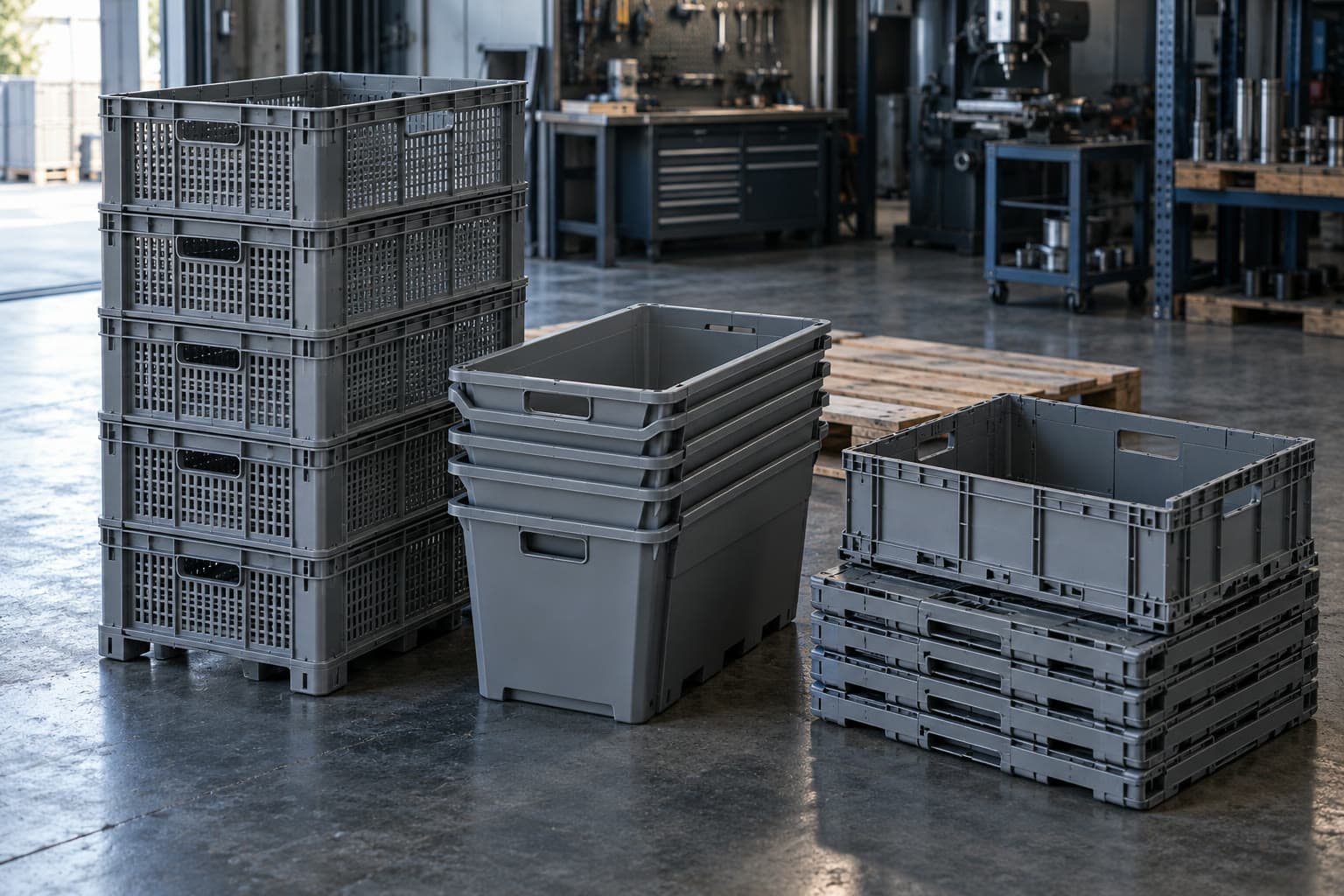
The main difference between the types is how they behave when empty:
- stackable — rigid straight walls: full crates are stacked high, but empty ones take up just as much room;
- nestable — tapered walls: empty crates nest inside each other, so returns cost less; to stack full crates, the design has supports — for example, the crate is turned 180°;
- foldable — the walls fold down and an empty crate becomes several times lower; these suit reusable loops over long distances.
Why 60 × 40
The 60 × 40 and 40 × 30 cm sizes are fractions of the 120 × 80 cm Euro pallet: one layer holds 4 crates of 60 × 40 or 8 crates of 40 × 30, with no gaps or overhang. The pallet is easier to wrap and the load does not shift in transit.
Crate height is chosen for the product: the more delicate the product, the lower the crate, so the bottom layers are not crushed.
Perforated or solid walls
Fruit and vegetables usually go into perforated crates: air circulates through the openings, the produce cools faster and keeps longer, and the crate is easier to wash. Solid walls are chosen for small products that could fall out and for warehouse use where protection from dust matters.
Which plastics crates are made of
Crates are usually made of high-density polyethylene (PE) or polypropylene (PP). Polyethylene takes impacts better in the cold, so it is often chosen for cold stores. Polypropylene is stiffer and lighter and is used, among other things, for foldable crates.
For direct contact with food, the material must be approved for such contact — check this with the supplier before ordering.
What to put in your order
To get an exact price, tell us:
- the crate type and size, or the model;
- the quantity;
- the colour;
- the walls: perforated or solid;
- what the crates are for: vegetables, fruit, other food or warehouse use.